
The Science of Motivation in Dog Training (And the Part Science Hasn't Figured Out Yet)
When a dog comes to me for training, one of the first things I'm assessing isn't the dog's behavior. It's their motivation.
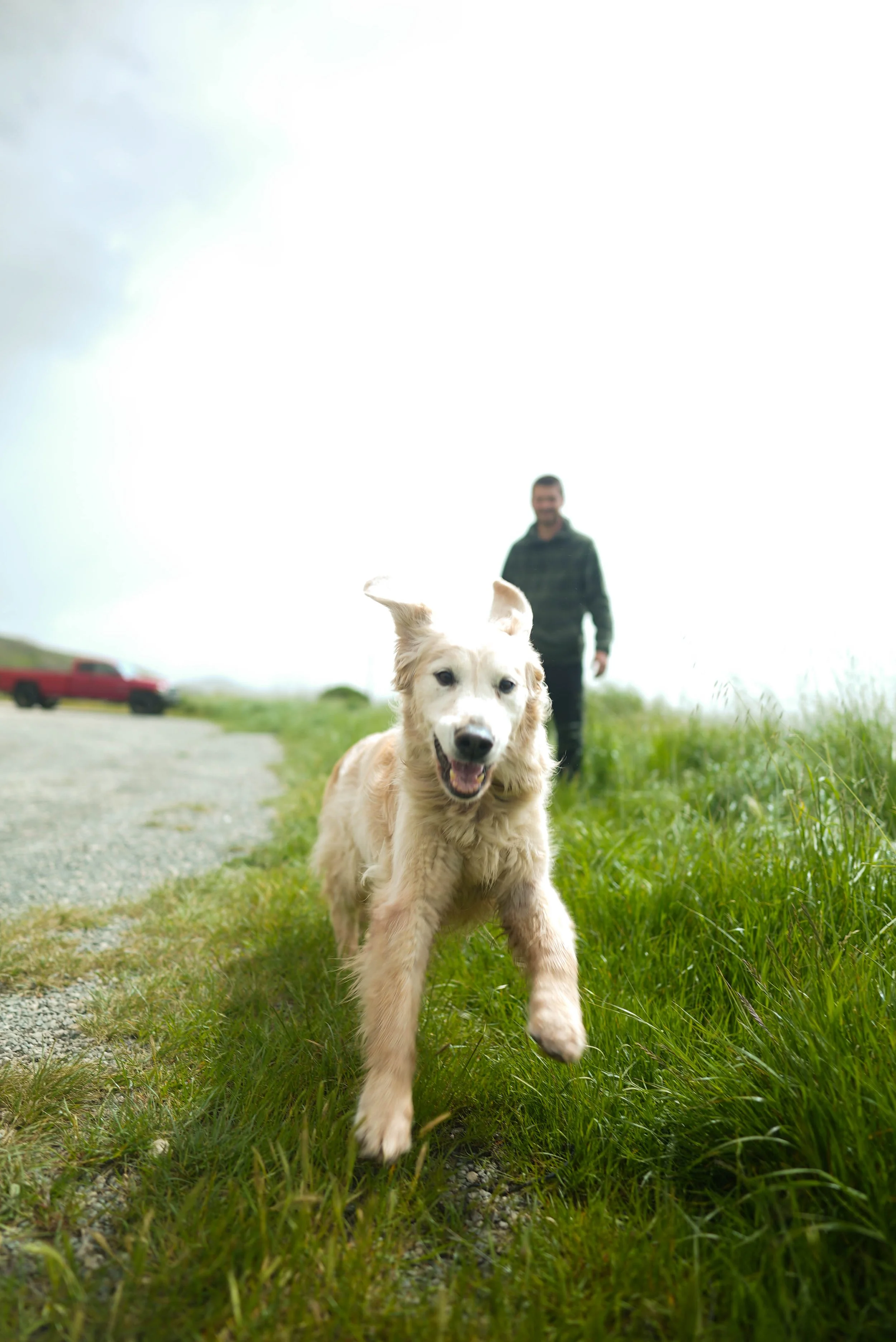
Golden retriever running through a field
And nine times out of ten, that's where the real work begins.
Most dogs that come through our doors share a similar profile: they're overweight, overfed, given free run of the house, and showered with affection on demand. Their owners love them deeply. That's never the question. But what that lifestyle creates, unintentionally, is a dog with very little reason to work. They have everything they want, all the time. Why would they hustle for a piece of chicken in your hand when there's a full bowl sitting in the kitchen?
This is the thing that doesn't get talked about enough in dog training. Everyone wants to jump to commands, to behavior, to technique. But if the dog isn't motivated, none of that matters.
WHAT THE SCIENCE ACTUALLY SAYS
The research on dog training motivation is interesting, and also incomplete.
The scientific framework closest to what we see in practice is something called motivating operations from Applied Behavior Analysis. The basic idea: deprivation or satiation changes how valuable a reward actually is. A dog that's just eaten a big meal doesn't care about your treat. Not because the treat changed, but because the conditions changed. A 2025 study from the American Journal of Veterinary Research confirmed what we already know on the ground. Dogs with high food availability at home are harder to motivate with food in training.
Research also shows that variable reinforcement produces the most persistent behavior. Think of it like a slot machine. Dogs (and humans) stay engaged longer when they can't predict exactly when the payoff is coming. Giving your dog a treat every single time for the same behavior actually creates a dog who quits faster when rewards stop. Varied, unpredictable reinforcement builds drive.
There's also research on what aversive training does to motivation. A study published in PLOS ONE followed 92 dogs across three years and found that dogs trained with punishment had higher cortisol levels after training sessions, showed more stress behaviors, and developed a pessimistic cognitive bias. When presented with ambiguous situations, they expected bad outcomes. They stopped trying.
Here's the part that often gets left out of how this study is discussed: the stress didn't simply come from the punishment itself. The same research cites a prior study on shock collar training showing that cortisol levels rose in direct proportion to how unpredictable the aversive was. The lower the predictability, the higher the stress. This is something I talk about constantly in the context of balanced training. A correction that is clear, consistent, and understood by the dog is a completely different thing than one the dog can't anticipate or make sense of. The science, when you actually read it, supports that distinction. But that nuance tends to get lost when researchers frame the question as simply "punishment versus reward."
A 2023 paper in Biological Reviews explored the concept of "flow" in animals, that state of absorbed, intrinsically motivated engagement. Dogs given choices in how they trained and what rewards they worked for learned faster and stayed more motivated. Control matters. Agency matters.
A NOTE ON RESEARCH BIAS
I want to be direct about something. The scientific literature on dog training skews heavily toward force-free methods, and that has shaped how studies are designed, what questions get asked, and how findings are interpreted.
A 2026 paper in Frontiers in Veterinary Science acknowledged this directly, noting that the professional dog training landscape has become "politicized," with training method choices tied to moral identity and ideological affiliation rather than evaluated purely on evidence. The same paper noted that much of the existing research relies on correlational designs and convenience samples, with observational studies vulnerable to expectancy bias.
That doesn't mean the research is wrong. It means it's incomplete, and it means practitioners who work across different training approaches often have context that the studies don't capture. Balanced training, done well, looks nothing like what most of these studies are actually measuring. And until researchers design studies that reflect that, the picture they're painting will keep being partial.
READING THE DOG: YOU DON’T PICK THE MOTIVATOR
One of the most important skills a trainer develops has nothing to do with technique. It's the ability to read a dog and figure out what actually matters to them.
This is where a lot of owners get stuck. They decide their dog is "not food motivated" and give up, when really the dog is plenty motivated, just not by what's being offered. The human doesn't get to choose the motivator. The dog does. A good trainer's job is to find it.
Some dogs are driven by food. Some are driven by play. Some are deeply motivated by belonging to a group and working alongside their handler. Others are most engaged when they get access to the environment: sniffing, exploring, moving through space. None of these is better than another. They're just different, and a trainer who only works with one type of reward is going to hit a wall with a significant portion of dogs.
Research backs this up. The Canine Reward Responsiveness Scale, developed in 2018, identified distinct motivational profiles across dogs, with food drive and toy drive operating as separate dimensions that don't always correlate. Genetics play a role too. Certain Labradors carry a gene variant associated with higher food motivation, which helps explain why the same breed can produce dogs who will work all day for a kibble and dogs who couldn't care less. Environment shapes it further. A dog raised with constant food access develops a different relationship with food as a resource than one who has learned that food is earned.
Once you've identified what motivates a dog, you can also use something called the Premack Principle, a concept from behavioral psychologist David Premack. The idea is straightforward: a behavior a dog highly wants to do can be used as a reward for a behavior they don't particularly want to do. If a dog loves to sniff the environment but doesn't want to walk nicely on leash, access to sniffing becomes the reward for loose leash walking. If a dog is obsessed with chasing a ball, retrieving it becomes the payoff for giving it up. You're not fighting the dog's natural drives. You're using them.
This is where training gets creative. And it's almost entirely absent from the scientific literature, because it requires reading an individual dog in real time, adapting on the fly, and drawing on pattern recognition built over years of practice. No study can replicate that.
WHERE THE SCIENCE FALLS SHORT
Here's my core issue with the research: it studies motivation as something to measure, not something you can build.
The literature asks "is this dog food motivated?" It doesn't ask "how do you take a dog with no food drive and create it?" Those are completely different questions, and only one of them is useful in the training room.
What I've learned after years of working with dogs is that motivation isn't fixed. It's a result of a dog's entire lifestyle: their diet, their freedom, their schedule, the way their owners interact with them. And it can be changed. That's the part no study has really cracked.
When a dog comes to us overfed and under-worked, the first job isn't training commands. It's restructuring the dog's relationship with resources. Food becomes earned, not free. Affection becomes intentional, not constant. Freedom is something the dog works toward. None of this is punishment. It's just creating conditions where working with you actually means something to the dog.
The research does touch on this with the concept of establishing operations, the idea that you can increase the value of a reward by changing the context. But it stops short of laying out what that actually looks like day to day. That knowledge lives with trainers, not in journals.
The Canine Reward Responsiveness Scale (Scientific Reports, 2018) is a good example of the gap. Researchers created a tool to measure individual differences in how dogs respond to rewards: food drive, toy drive, social motivation. Useful. But the scale treats these as fixed traits. In practice, we know they're not. I've worked with dogs who came in with zero food motivation and left with real drive, because we changed the conditions that created the apathy in the first place.
WHAT THIS MEANS FOR YOUR DOG
If you're struggling to train your dog, before you look at your technique, look at the lifestyle.
Is your dog eating free-choice or on a schedule? A dog who grazes all day has no reason to work for food. Is affection given on demand, any time the dog nudges your hand? Then affection has no value as a reward. They can get it for free. Does your dog have total freedom in the house before they've learned any rules? Freedom without structure doesn't build confidence. It creates anxiety and a lack of direction.
None of these changes are unkind. They're the foundation that makes training possible.
The science gives us a useful framework. Reinforcement matters, consistency matters, unpredictability creates stress, and variable reward schedules build drive. All of that is true and worth knowing.
But the part that actually transforms a dog? Building motivation where there wasn't any? That's still practitioner knowledge. That's still what happens in the training room, figured out dog by dog.
And that gap is exactly why good trainers matter.
