
It's Not the Tool. It's the Uncertainty.
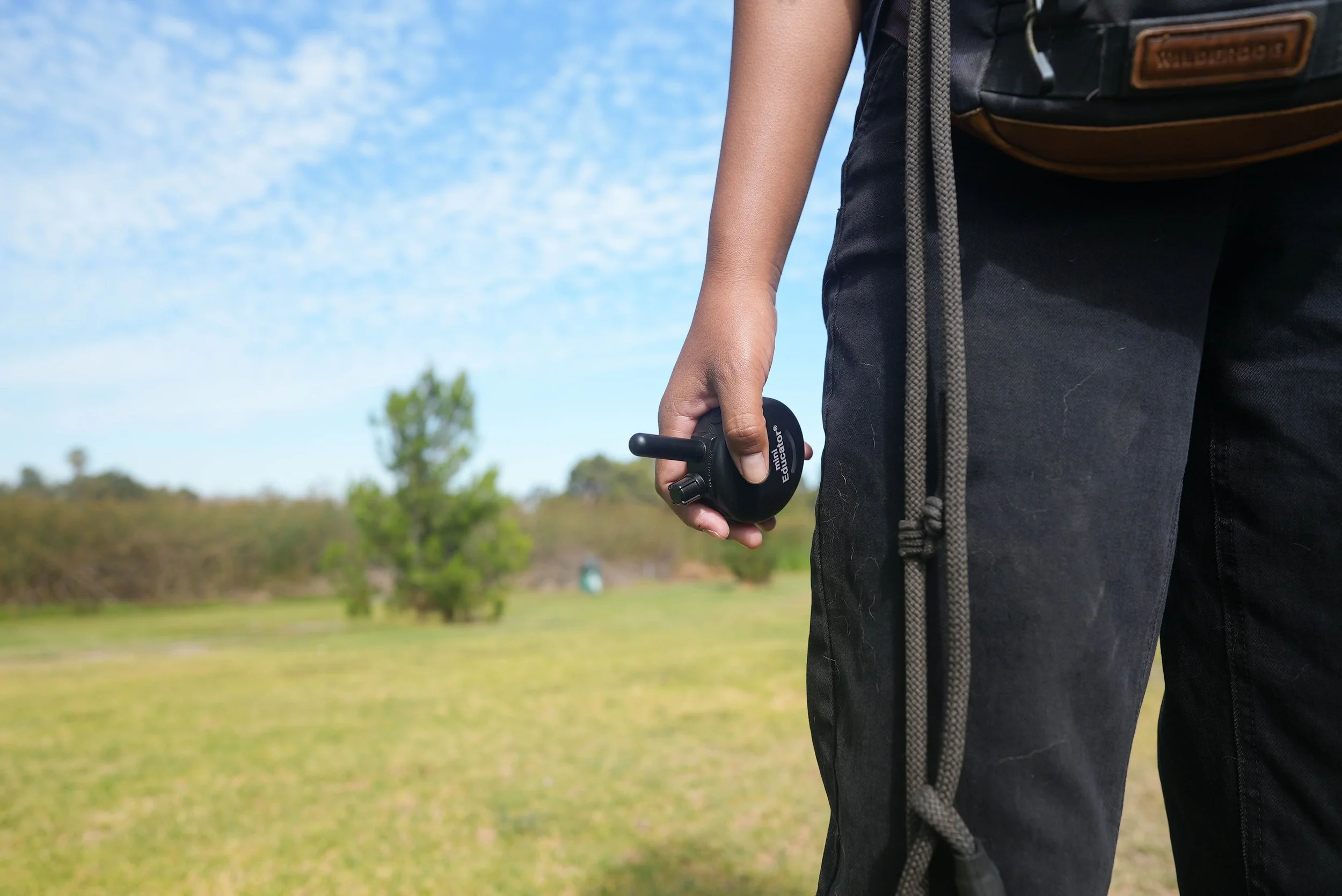
Dog trainer holding an ecollar remote
When I put an ecollar on a dog for the first time, the dog does not flinch. They do not panic. They do not shut down. They go, "Oh, I know what that means. I just do this and it stops."
That is the whole point. And it is exactly what the science says should happen when it is done right.
The conversation about aversive tools in dog training has been stuck in the wrong place for years. It gets framed as "tools that hurt versus tools that do not." But that is not what the research actually shows. What the research shows is that stress in training is caused by one thing above all others: the inability to predict and control what happens next.
WHAT THE SCIENCE ACTUALLY SAYS
The most important study on this topic that almost no one talks about in full was conducted by Schalke and colleagues. They exposed three groups of dogs to low-level electric stimulation and tracked cortisol levels across the groups. What they found was striking.
The group that received stimulation randomly, with no connection to anything the dog was doing, showed a 327% spike in cortisol and displayed severe, persistent stress responses. The group that received stimulation tied to a specific command the dog already understood showed no considerable or persistent stress at all. The variable was not the stimulus. The variable was whether the dog could predict it and, more importantly, whether the dog could turn it off by doing something specific.
The PLOS ONE study from 2020 that gets cited constantly found higher stress in aversive-trained dogs compared to reward-trained dogs. What rarely gets mentioned is that the same paper references the Schalke findings. The stress was not from consequence itself. It was from unpredictability. From dogs not understanding what was happening or how to make it stop.
This matters enormously for how we interpret the research. The studies measuring stress in aversive training are, almost universally, measuring aversives applied without the dog having a clear, pre-taught behavior to fall back on. The aversive arrives and the dog has no roadmap. Of course that is stressful. Of course cortisol spikes. Uncertainty is one of the most potent psychological stressors that exists, for dogs and for humans.
Source: Schalke et al., "Clinical signs caused by the use of electric training collars on dogs in everyday life situations"
Source: PLOS ONE (2020), "Does training method matter?"
https://journals.plos.org/plosone/article?id=10.1371%2Fjournal.pone.0225023
WHERE THE RESEARCH FALLS SHORT
Here is the problem with virtually every ecollar study published: they test the ecollar as a teaching tool. The collar is used to create the behavior from scratch. The dog does not know what is expected. The stim arrives, the dog scrambles, and eventually something works. That is not how skilled balanced trainers use an ecollar. It is not even close.
A 2026 paper in Frontiers in Veterinary Science acknowledged that dog training research has become "politicized," with method choices tied to moral identity rather than evidence. The same paper flagged real methodological problems: correlational designs, convenience samples, and expectancy bias in observational studies. These are fundamental limitations that shape what conclusions can fairly be drawn.
The research is not studying balanced training as it is actually practiced. It is studying a version of aversive use that most balanced trainers would also criticize.
Source: Frontiers in Veterinary Science (2026)
https://pmc.ncbi.nlm.nih.gov/articles/PMC12975608/
HOW BALANCED TRAINING ACTUALLY USES THE ECOLLAR
The methodology matters. This is what gets lost entirely in the public debate.
When a balanced trainer introduces an ecollar, the behavior already exists. The dog knows sit. The dog knows come. The dog knows place. They have practiced these behaviors hundreds of times with positive reinforcement and they respond reliably in low-distraction environments. Only then does the ecollar come out.
At that point, the ecollar is introduced at the lowest level the dog can feel, and the dog is given a cue for a behavior they already know. The moment they perform it, the stim stops. That is it. The dog learns one thing: I can turn this off. I know exactly how. I do the thing I already know how to do.
This is the opposite of the random group in Schalke's study. The dog is not scrambling to figure out what the stimulation means or how to escape it. They already know. The ecollar becomes a communication tool, not a source of confusion.
What this produces, in practice, is a dog who is calm when the collar goes on. A dog who is confident under distraction because they have a clear way to respond. A dog whose relationship with their handler does not change because the handler has not become unpredictable. The collar is just another cue in a language the dog already speaks.
WHAT THIS MEANS FOR YOUR DOG
If you are considering ecollar training, the most important question is not whether to use one. The most important question is whether your dog knows the behaviors you want to reinforce before the collar is ever introduced.
If the answer is no, the collar is not the next step. Building the behavior is.
The stress in aversive training comes from the dog not knowing how to make it stop. Remove that uncertainty and you remove most of the welfare concern. A dog who understands what is expected, who has a clear way to respond, and who can predict the outcome of their actions is not a stressed dog. That is true whether the reward is a treat or the removal of a light stim.
Predictability is not just a training principle. It is a welfare principle. And skilled trainers have understood this long before the research caught up.
